
The ‘Donroe doctrine’: Maduro is the guinea pig for Trumps new world order
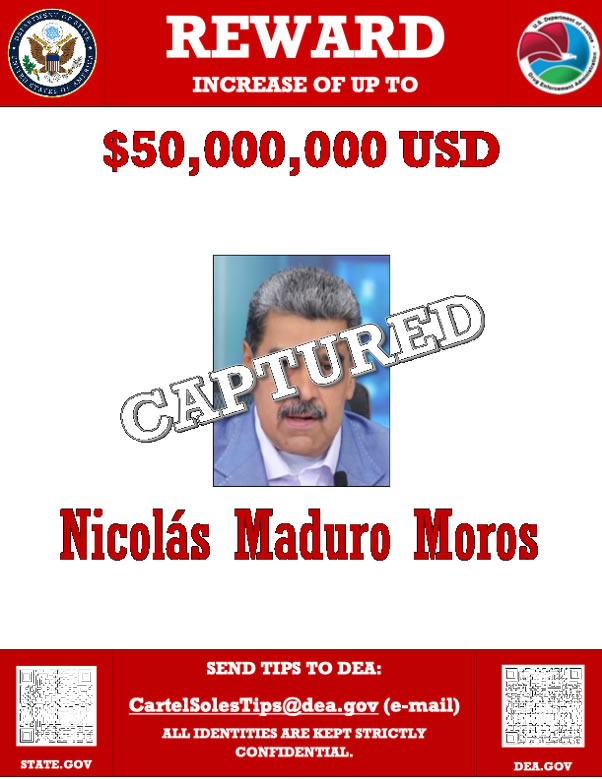
Shortly after US special forces captured and extracted Nicolás Maduro and his wife, Cilia Flores, on November 3, Donald Trump said that the US would now “run” Venezuela.
Whatever Washington’s plans for the future of Venezuelan governance, this show of US force in Latin America looks like the first manifestation of a more assertive American foreign policy outlined in the national security strategy published in November 2025. This plainly asserted the Trump administration’s intention to “reassert and enforce the Monroe doctrine to restore American pre-eminence in the Western Hemisphere”.
“America can project our will anywhere, anytime.”
Rather than force regime change at this point, Trump has indicated that he is willing to work with Maduro’s vice-president, Delcy Rodriguez, who has been sworn in as president. Rodríguez has adopted a conciliatory tone, inviting the US government to “work together on a cooperative agenda”. For the US president, “cooperation” will involve giving US oil companies unfettered access to Venezuela’s oil reserves, the largest in the world.
Announcing the raid at a press conference held hours after American forces snatched Maduro, Trump appeared to issue threats of similar interventions in Colombia, which he said was run by a “sick man who likes to make cocaine and sell it to the US”. His secretary of state, Marco Rubio – the child of Cuban exiles – also hinted at US intentions towards Cuba, saying: “If I lived in Havana and I was in the government, I’d be concerned at least a little bit.”
The US secretary of defense, Pete Hegseth, was perhaps most revealing of the three, talking about the administration’s goal of “reestablishing American deterrence and dominance in the Western Hemisphere”. In a clear warning to US foes, Hegseth said that no other country could have pulled this operation off, adding: “Our adversaries remain on notice. America can project our will anywhere, anytime.”
This is worrying in terms of geopolitics for two reasons.
First, the administration has shown a remarkable lack of engagement with international law. It has chosen instead to frame the raid as a police action to apprehend Maduro as a “narco-terrorist” responsible flooding the US with drugs.
This thin veil of legality has proved successful in the past. In 1989, the administration of George H.W. Bush ordered the invasion of Panama to capture the strongman dictator Manuel Noriega. Noriega was tried in Miami and jailed for 20 years on charges of being a sponsor of illicit drug trafficking.
Despite the UN passing a resolution condemning the invasion as a “flagrant violation of international law” (vetoed by the US, UK and France) the invasion enabled the US to take control of the canal. It held the canal for a decade before handing over operations to the Panama Canal Authority on December 31 1999.
The success of Bush’s invasion could explain why the Trump administration is taking a similar approach with Venezuela. Washington’s official line been to focus on Maduro’s alleged criminality rather than any US ambition to affect regime change in Venezuela.
Hegseth also insisted that the raid was about “safety, security, freedom and prosperity for the American people”. This assertion succinctly captures how the parameters of US national security have evolved to be much broader than defence. They now appear effectively inseparable from advancing US economic interests globally.
It’s an updated version of the Monroe doctrine, which the national security strategy described as the “Trump corollary”, but which the president himself has referred to as the “Donroe doctrine”. The term, which appears to have been coined by the New York Post (but which Trump nonetheless appears to have taken a liking to – as with most things that bear his name) is a vision of geopolitics which projects US power across the Americas.
And it looks set to be used to grab whatever resources the US perceives as beneficial to its interests, from Greenland’s minerals and strategic position to the Panama canal and Venezuelan oil.
A new era of interventionism?
Naturally, it is in Latin America where these threats become more palpable. The 1823 Monroe doctrine – developed under the then president, James Monroe – designated the western hemisphere as an area of US influence in which the European powers of the time were explicitly warned not to interfere. Seven decades later, the 1904 “Roosevelt corollary” added the principle that the US could interfere in any Latin American countries plagued by “wrongdoing or impotence” and “requiring intervention by some civilized nation”.
an era of “rogue superpowers” and the “Putinisation” of US foreign policy.
This principle was invoked to justify direct occupation of Latin American countries contrary to US interests in the early 20th century. In this century, China’s growing links in Latin America have prompted a resurgence of references to the Monroe doctrine – particularly by Republican Congress members.
In 2026, these developments highlight the Trump administration’s willingness to enhance the capabilities of this outlook. It is not clear how the Donroe doctrine differs from its predecessors. But like them, it seems to subordinate international law to national interest.
And while it is aimed at a global audience, it also appears to entitle powerful countries with the right of having spheres of influence. Commentators have referred to this as an era of “rogue superpowers” and the “Putinisation” of US foreign policy.
The absence of conspicuous military support for Maduro from either Russia or China reinforces those arguments. China reportedly buys 76% of Venezuelan oil, while Moscow has in recent years had strong military ties with Caracas. The two countries have also cooperated closely to help each other avoid US oil sanctions.
The new US foreign policy stance as exemplified by the snatching of Maduro means the world is more dangerous – and Latin America considerably more vulnerable. But for now it’s Venezuela, which appears to be the laboratory where Trump has decided to flex America’s geopolitical muscles.
And it looks as if Maduro is the unlucky guinea pig, whose fate is designed to indicate what the world’s most powerful military can and will do to advance its economic and national security interests around the world.
Author: Pablo Uchoa; PhD Candidate in International Politics, Institute of the Americas, UCL
First published in The Conversation

Sites linking to this page have chosen to adopt this Privacy Policy as their own. This means: they agree to abide by the principles laid out below.
In common with other websites, log files are stored on the web server saving details such as the visitor's IP address, browser type, referring page and time of visit.
Cookies may be used to remember visitor preferences when interacting with the website. Where registration is required, the visitor's email and a username will be stored on the server.
The information is used to enhance the visitor's experience when using the website to display personalised content and possibly advertising.
Email addresses will not be sold, rented or leased to 3rd parties. Email may be sent to inform you of news of our services or offers by us or our affiliates.
If you have subscribed to one of our services, you may unsubscribe by following the instructions which were included in the email that you received.
You can block cookies via your browser settings but this may prevent you from accessing certain features of the website.
Cookies are small digital signature files that are stored by your web browser that allow your preferences to be recorded when visiting the website. Cookies are used by most websites to record visitor preferences. Also they may be used to track your return visits to the website.
Like all sites, we use 3rd party tools to help us run the website. They are used not to track you but to track info like the visitors numbers on the site over a given period, to allow you to interact with the social-media widget and to allow us to login into this web based CMS (Content Management System).