
Honor Bright – Was there a Miscarriage of Justice?
At the foothills of the Dublin Mountains there is a plaque bearing the words ‘In memory of Honor Bright – RIP June 9th, 1925’. Who was Honor Bright? What was she doing on the streets of Dublin, and did she bear W.B. Yeats’s child? Samantha Bailie reports:
Honor Bright, whose real name was Lizzie O’Neill, lived in a tenement house in the Liberties area of Dublin. It is not known why she changed her name, but one suspects she did so due to the nature of her work, after all, it is not unusual for prostitutes to go by an alias. Honor found most of her clients in the St. Stephen’s Green area of the city, and she was well known by both punters and guards as one of the more popular streetwalkers.
As the taxi driver headed back towards the Green, a grey sports car, matching the description of Purcell’s raced past him…
On the last night of Honor’s life, she had been pacing the streets of St. Stephen’s Green, an area used as a promenading ground to tout for trade. Just after 2 am a taxi driver stated that he spotted Honor being called over to a grey 2-seater sports car that had pulled up between Kildare Street and the entrance to Shelbourne. The man (Dr. Patrick Purcell) told Honor that one of the other prostitutes had just stolen £11 and a silver cigarette case from him; he showed her a pistol and said he would use it if he found her again.
Honor was unsure what this man wanted from her, but it soon became apparent when he told her he would pay her ten shillings for her services in locating the prostitute who had defrauded him. Honor was unsure, after all, she had to work with these girls every night, it wouldn’t be a good idea to ‘sell out’ another girl, but then she looked at the pistol and the stern look in the man’s eyes and knew there was trouble ahead.
Purcell, as if sensing her reluctance, stated that she had better be practical and help him out, as his friend (Leopold Dillon), a superintendent in the Civil Guard was parked right across the road and could make her life, and that of the other prostitutes, very tough. Honor looked across the road and spotted the man she was being threatened with. As if to ensure her cooperation, he again threatened that he and his friend would ensure that none of the girls made money again in the area, so Honor agreed, albeit reluctantly, to help him.
Bright got into the car and Purcell gave her a description of the accused, describing her as a girl with bobbed hair and a grey outfit. His next sentence would send chills through her body though, “If I get her I will put a gun through her mouth and bring her to the country, where no one will find her, and if I don’t get her, some other girl will fall victim.” It is unknown what went on in the car, but Honor must have got out of the vehicle as she got a taxi from the Green and was dropped off at Leonard’s Corner, (the junction of South Circular Road and Clanbrassil Street) just a couple of minutes walk from her house.
As the taxi driver headed back towards the Green, a grey sports car, matching the description of Purcell’s raced past him (with a man in beside him) towards the area he had left Honor. In an era when cars were not common, and sports cars were even more unusual, the taxi driver felt positive that this was definitely Purcell, as the car was an eye-catcher.
Near 4 am, a guard was going past Harold’s Cross when he spotted two men and a woman talking. He noted that when they spotted him they jumped in the car and sped off towards Terenure. This would actually be the final sighting of Honor Bright - her body would be discovered the next morning, (Tuesday, 9th June 1925) at the crossroads in Ticknock near Lamb Doyle’s pub, (an area sparsely populated and known as something of a lonely spot) fully clothed in a grey dress and a red hat with a bullet wound through her right breast. Beside her lay a partially smoked cigarette. The shoe from her left foot was missing and it lay a distance from the body, as if there had been a struggle or it was thrown perhaps?
The media was instantly all over the case, almost serializing it like it was some kind of soap opera. Perhaps the name Honor Bright didn’t somehow feel like a real person to people, but that of a fictional character – who knows? Details of the crime began to emerge through the local press, albeit in a highly sensationalized fashion. It cannot have been easy for her family and friends.
On 4th July two men were arrested and charged with Honor’s murder: medical doctor Patrick Purcell (from Blessington) and ex-superintendent of the Civic Guards, Leopold Dillon (from Dunlavin in Wicklow). The pair had evidently driven to Dublin in the grey sports car on the night of Monday 8th June, returning to Blessington in the early hours of the next morning.
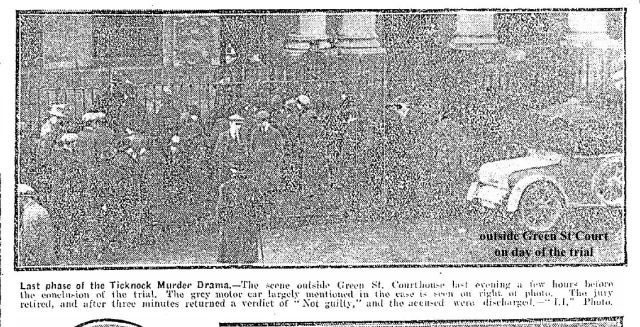
Unsurprisingly crowds swamped outside the Green Street courthouse where the Central Criminal Court was sitting, and witnesses and court officials could barely get past locals vying to hear any snippet of information they could gleam.
The counsel for the defence characterised the two men as having fallen victim “to the lure of wine and women” but emphasized that this did not, by any means, make them “moral degenerates.” The defence suggested that Honor “must have fallen into the hands of the police” and that she was brutally murdered “by some of those sinister societies that had arrogated to themselves the power of life and death.” The prosecution did not take this suggestion seriously.
Very soon the ever-expanding crowds outside the courthouse would get the new gem of information they were waiting on – the verdict. On 30th January 1926, after a mere three minutes of deliberation, the jury found the defendants not guilty and acquitted them both, as they believed there were doubts, and Purcell and Dillon walked away as free men. Were these men innocent or did their station in life place them above the law, after all, it was the 1920’s and they were both ‘gentlemen’ and professionals (doctor and an ex-superintendent) whereas Honor Bright was just a street-walking hooker, turning tricks to make a shilling.
The public certainly made their own decisions - the superintendent's career was in ruins and Dr. Purcell found life so problematic in Blessington among the local people that he moved to England. Everyone believed these two men walked free despite the fact that all evidence pointed to them.
Interestingly, it was rumoured that Honor Bright may have had an affair with W. B. Yeats resulting in the birth of a boy, whom they allegedly placed in foster care. Whether or not this is true is very debatable, but Patricia Hughes who claims to be the granddaughter of Yeats (and daughter of Honor and Yeats’s son) has written a self-published book ‘W.B. Yeats and the Murder of Honor Bright’. There appears very little concrete evidence to suggest that this was actually true but Hughes believes this to be the case and in an era when so much was hidden from public scrutiny, who knows?
Honor Bright's memory lives on, thanks to that little plaque in the mountains, but sadly her killers never paid, and justice was never served.

Sites linking to this page have chosen to adopt this Privacy Policy as their own. This means: they agree to abide by the principles laid out below.
In common with other websites, log files are stored on the web server saving details such as the visitor's IP address, browser type, referring page and time of visit.
Cookies may be used to remember visitor preferences when interacting with the website. Where registration is required, the visitor's email and a username will be stored on the server.
The information is used to enhance the visitor's experience when using the website to display personalised content and possibly advertising.
Email addresses will not be sold, rented or leased to 3rd parties. Email may be sent to inform you of news of our services or offers by us or our affiliates.
If you have subscribed to one of our services, you may unsubscribe by following the instructions which were included in the email that you received.
You can block cookies via your browser settings but this may prevent you from accessing certain features of the website.
Cookies are small digital signature files that are stored by your web browser that allow your preferences to be recorded when visiting the website. Cookies are used by most websites to record visitor preferences. Also they may be used to track your return visits to the website.
Like all sites, we use 3rd party tools to help us run the website. They are used not to track you but to track info like the visitors numbers on the site over a given period, to allow you to interact with the social-media widget and to allow us to login into this web based CMS (Content Management System).