
Christine Smith takes a look at the surprising and interesting stories behind the films we always seem to watch at Christmas.
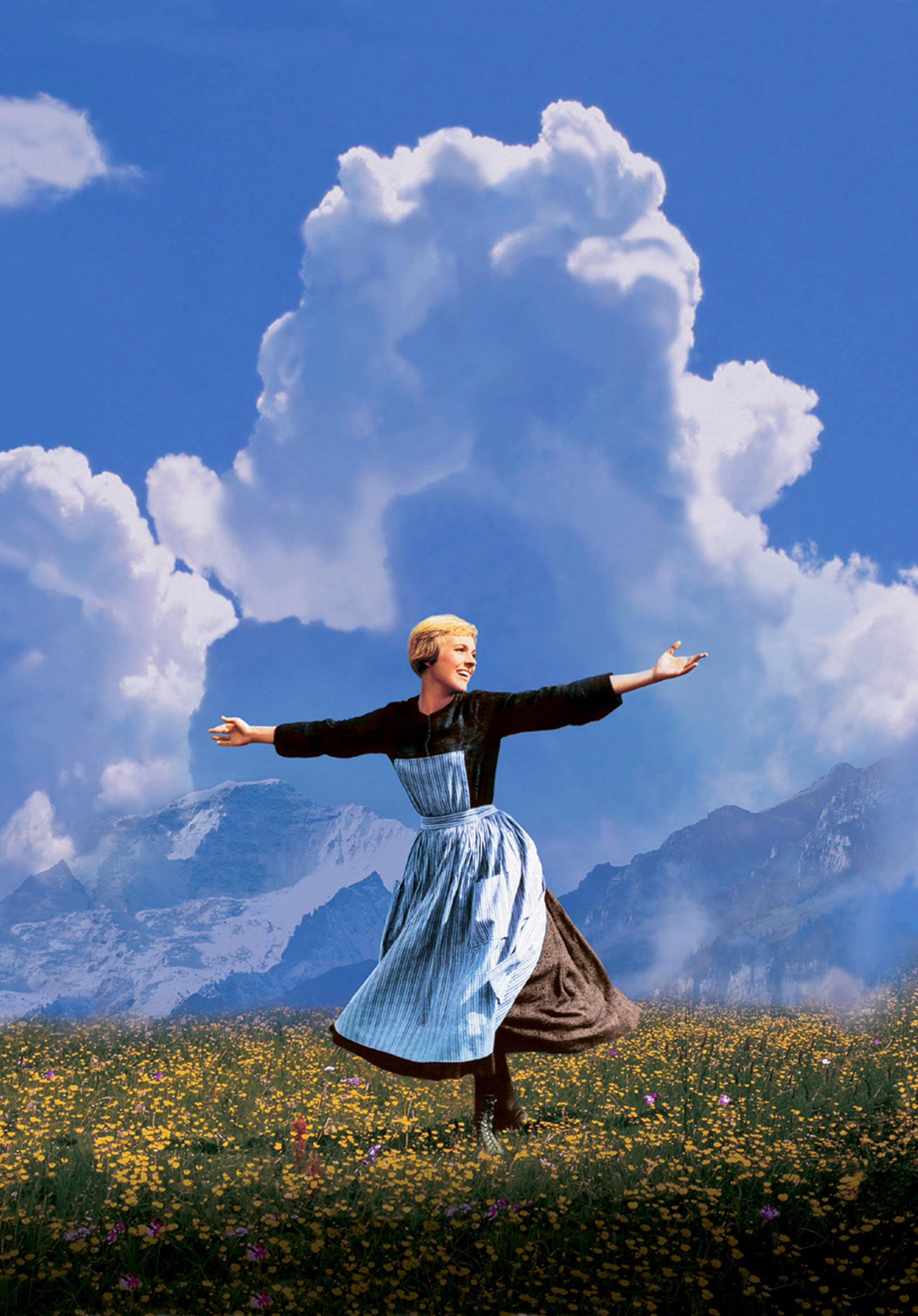
Oh, don’t we all love to snuggle up this time of year and watch something from yesteryear? There’s something so warm and comforting, watching the films we loved as children, when life seemed to be so much simpler and our films much more innocent. I know I just love the 1965 classic ‘The Sound of Music’, the film derived from the Broadway Musical of the same name, with those (cheesy) but sing-a-long favourites from Rodgers and Hammerstein like ‘My Favourite Things’ and ‘Climb Ev’ry Mountain’, but did you know that the film was actually based on a real family?
The real Maria von Trapp (then Maria Augusta Kutschera) was born in Vienna and became an orphan as a small child, so was sent away to a distant relative. Maria upon completion of her schooling went to teacher training college and then joined The Roman Catholic Benedictine Abbey of Nonnberg in Salzburg, and this is where The Sound of Music starts the story of Maria’s life.
Despite the romantics out there believing she fell instantly in love with the Baron – she didn’t
A recently widowed Baron by the name of Georg Ritter von Trapp was struggling desperately with his 7 children, as one of his daughters, who was also named Maria was very weak with Scarlet Fever, so he approached the Reverend Mother of the Abbey for help and she sent Maria to aid the retired captain of the Austrian Navy. Maria fell in love with the beautiful country house she was sent to in Aigen, just outside Salzburg, and one by one she came to love the children as her own. Despite the romantics out there believing she fell instantly in love with the Baron – she didn’t.
In her autobiography ‘Maria’ she said she fell in love with the children at first sight, not their father. When he proposed marriage, she was not sure if she should forsake her religious calling, but was advised by the nuns to do God's will and wed Georg. "I really and truly was not in love. I liked him, but didn't love him. However, I loved the children, so in a way I really married the children…… by and by I learned to love him more than I have ever loved before or after." The couple married on 26th November 1927 and went on to have 3 children.
When the depression hit in the early 1930’s, Georg lost the family’s money in the banking crash and they had to open up their house to lodgers in order to make ends meet.
One of the boarders who came to stay was Father Franz Wasner, a musician who told them their musical abilities could earn them a living, so he became their arranger, composer and conductor, and in 1938 he left with the family when they fled from Nazi occupied Austria to reside in Italy and then the USA, where they set up home in Vermont (as it reminded them of Austria) and they toured the States and 30 other countries as The Von Trapp Family Singers. In fact, they became so popular that demand grew for recordings of the family and they released records and even appeared on an Elvis Christmas record.
It was Maria von Trapp who decided to sit down and write an account of her life in a book called The Story of the Trapp Family Singers, and a German producer happened to stumble upon it and bought the rights for a very modest fee – the Von Trapps made very little from the film, which is quite sad, but at least their story lives on through film and I’m quite sure most of us will catch it (again) over the Christmas period.
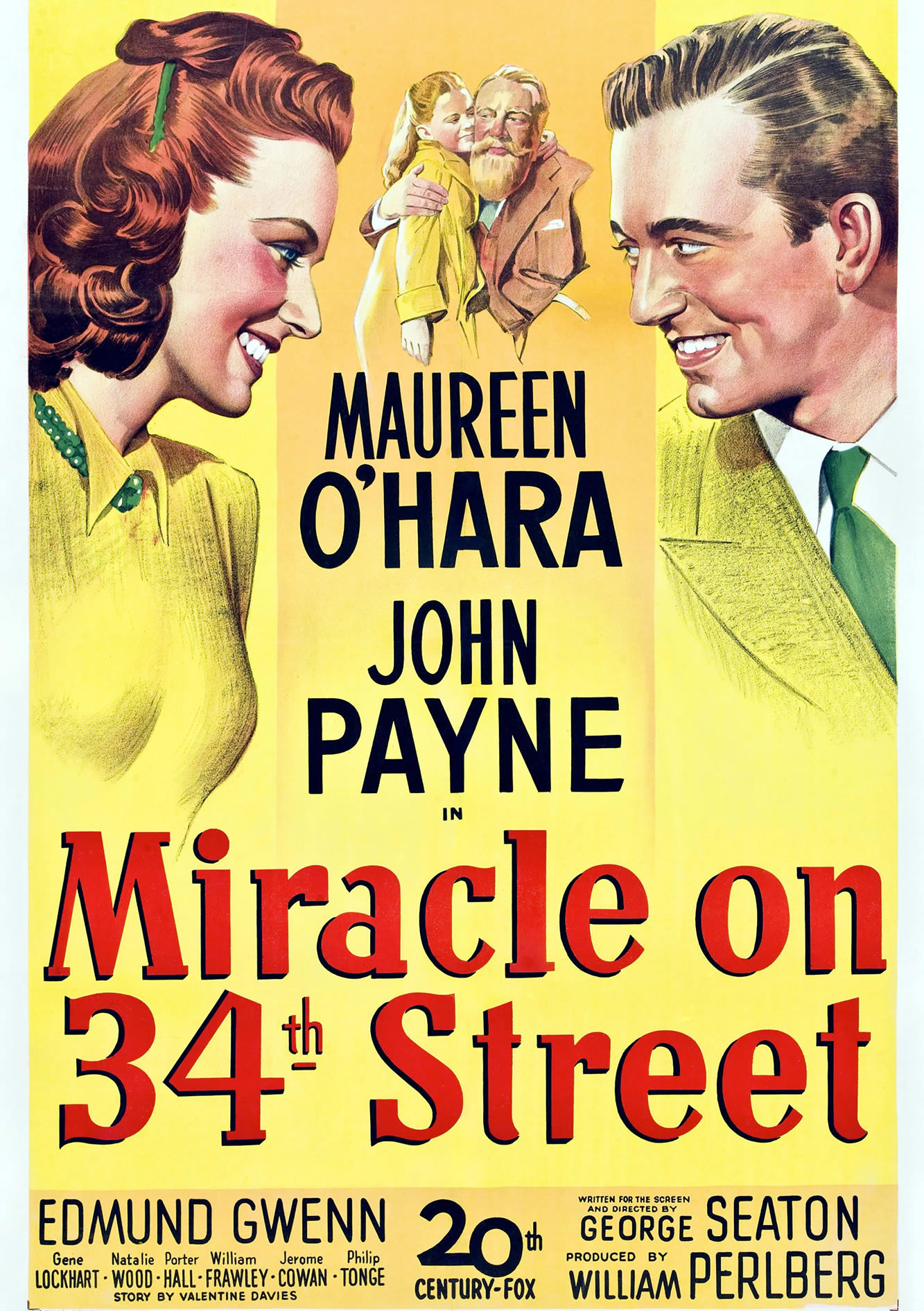
Another movie that is repeated every year (and you catch yourself watching each time) is ‘Miracle on 34th Street’, the film starring our very own Maureen O’Hara and John Payne. Problems began almost instantly as Darryl F Zanuck; the shrewd head of Twentieth Century Fox hated the story and only agreed to make the film if director George Seaton would agree to accept his next movie assignment without any complaint. (That film would be The Shocking Miss Pilgrim starring Betty Grable and Dick Haymes).
Aged just 7 Natalie possessed none of the precociousness of other child stars – in fact, adults on set nicknamed her “One-Take-Natalie”…
The movie was originally titled ‘The Big Heart’ and George Seaton agonized over who would play the little girl who didn’t believe in Santa – no child seemed to fit the image he had in his head, and then an assistant remembered seeing a child who could cry on cue – Natalie Wood. Aged just 7, Natalie possessed none of the precociousness of other child stars – in fact, adults on set nicknamed her “One-Take-Natalie” as she knew her lines word perfectly and never needed a retake. Despite having a perfect cast, the film was dogged by logistical problems – the scene where St. Nicholas was taken to Bellevue was shot without permission and the hospital staff wouldn’t cooperate because they had been portrayed badly in earlier movies, so the filmmakers were forced to shoot only the car approaching the building’s entrance and they recreated the famed psychiatric ward’s interiors back in LA.
If that wasn’t bad enough, they had great difficulty getting permission to shoot the Macy’s parade from the apartment dwellers on 34th Street, which had to be done right the first time. The film crew paid the ladies of the house to put cameras in their windows, but in some cases, husbands came home, complained about the inconvenience and demanded their own cut!
The problems continued. Edmund Gwenn who of course played Kris Kringle (and would win an Oscar for his performance) suffered from a debilitating bladder control problem, but refused to allow anyone else to take his place in the parade, so tubes had to be hidden under his cloak to deal with the problem.
When the film was completed, the studio bosses were underwhelmed and released it in June, but despite all of this, the movie was a big hit with the 1947 audiences and of course went on to become one of our staple Christmas movies.
We can’t mention seasonal viewing without ‘Singin’ in the Rain’ starring Gene Kelly and Debbie Reynolds. Who can forget the joyful and soaking Gene Kelly in one of the most iconic sequences in film history? For female lead Kathy Seldon, stars like Judy Garland and June Allyson were considered, but Gene Kelly was determined the part would go to Debbie Reynolds, who had previously only had a couple of small roles after she was discovered at a beauty pageant. Kelly was convinced the teenager has the athleticism and vocal range for the part, but Reynolds was full of self-doubt and with no dance training felt she was in over her head. Kelly was a tyrannical taskmaster and demanded that Reynolds perfect each step.
One day she became so dejected that she hid under a piano and sobbed. Fred Astaire found her and told her he would give her some dance coaching, and by the time she filmed the Good Morning number she was able to keep up with Gene Kelly and Donald O’Connor. Immediately after the 14-hour scene though she had to be carried to her dressing room, feet bleeding and mentally and physically exhausted. Years later she would cite the two hardest things she had ever done: childbirth and Singin’ in the Rain!
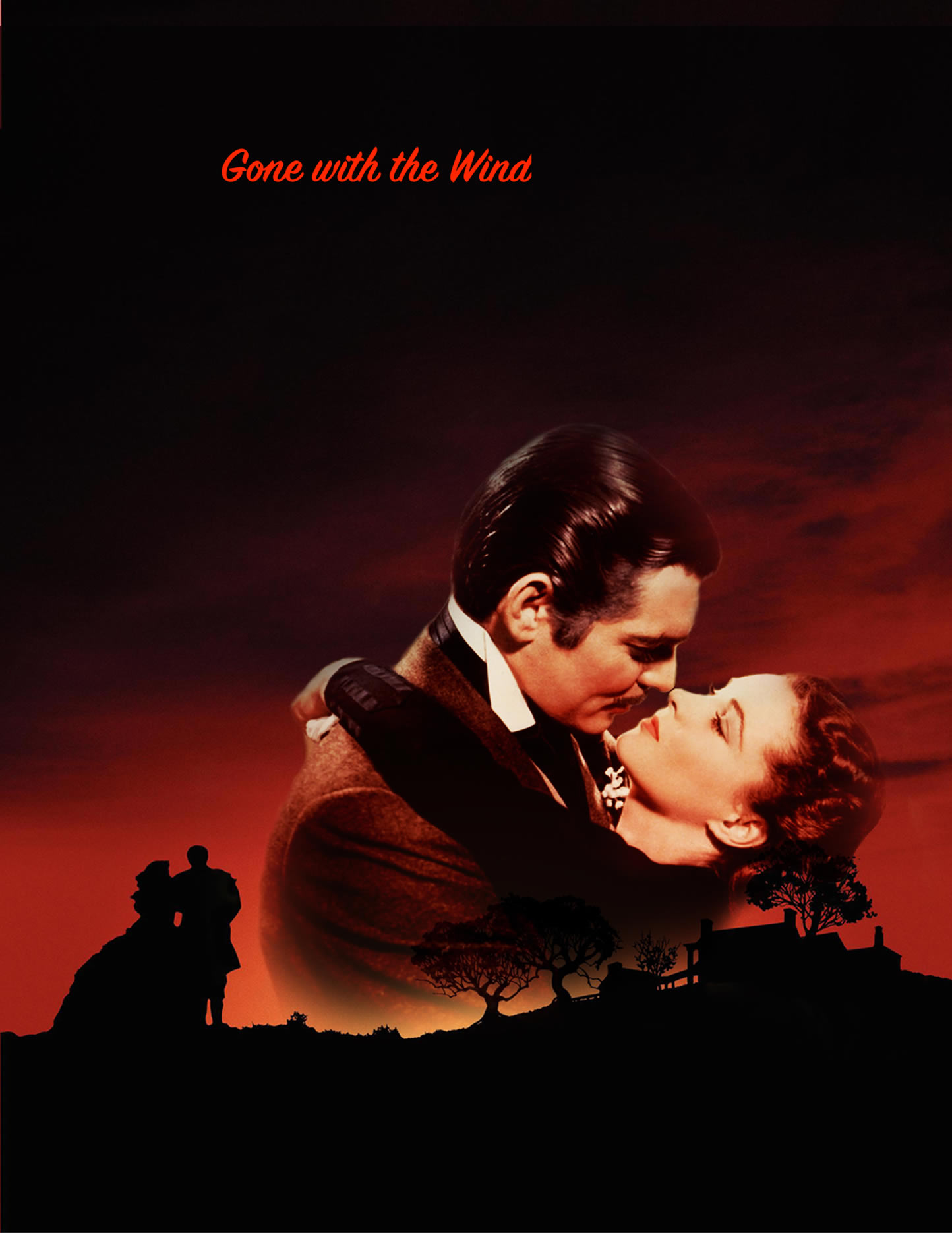
Another film we all get caught up in during Christmas if of course ‘Gone with the Wind’ starring Vivien Leigh and Clark Gable, but did you know that the 1939 film almost didn’t happen? Author of the book, Margaret Mitchell had written the 418,053 word book due to boredom when she was stuck in bed after an accident, but when a friend read it, she suggested it be given to Macmillan Publishing, but Mitchell said the book was just for herself and when she discovered her book had been sent to Macmillan, she sent a telegram asking for it back, but they refused. The book was a huge success and the movie rights were bought right away for $50,000 (the company later gave Margaret another $50,000 as they said she’d been underpaid) but she never wrote another book, as she hated the publicity ‘Gone with the Wind’ brought her.
Back to the film though – would you believe that the search for the perfect Scarlett cost over $1.6m in today’s money and more than 1,400 women were auditioned, with 400 actresses reading for the role, 19 were given screen tests and only 2 were shot in Technicolor – Paulette Goddard and Vivien Leigh. Goddard may well have got the role but she was living with Charlie Chaplin out of wedlock and thus perceived as too controversial for the role (yet Leigh was openly having an affair with the married Laurence Olivier at the same time!!)
The production of the film was a huge mess; just 3 weeks into filming, the director was fired, the script was written, rewritten, altered, lengthened and changed several times, then 5 weeks into filming, a new script was commissioned and finished in five, 20 hour days, during which the producer didn’t allow anyone in the room to have any food breaks – they lived only on bananas! Unsurprisingly staff had to break due to extreme exhaustion. One of the reasons the pace was so fast was that Vivien Leigh wanted to go back to Olivier who couldn’t be in Hollywood with her.
Then Clark Gable pulled a huge strop when he was informed that his character Rhett Butler had to cry. He refused. The director insisted and Gable said he would quit before he would cry, but eventually Olivia de Havilland (whose character Melanie shares the scene) convinced him, much to Leigh’s relief, as she was getting rather annoyed at him holding up production (and keeping her away from her man). Her anger probably fuelled her remarks when asked about kissing her co-star Gable:
"Kissing Clark Gable in Gone with the Wind was not that exciting. His dentures smelled something awful."
Despite everything, ‘Gone with the Wind’ was the first film to receive more than 5 Academy Awards, receiving 8 regular and 2 special Oscars (this record stood for 20 years until Ben-Hur won 11 in 1959).
So, whatever you watch this year, remember – the story behind the scenes can be just as interesting as what you are watching.

Sites linking to this page have chosen to adopt this Privacy Policy as their own. This means: they agree to abide by the principles laid out below.
In common with other websites, log files are stored on the web server saving details such as the visitor's IP address, browser type, referring page and time of visit.
Cookies may be used to remember visitor preferences when interacting with the website. Where registration is required, the visitor's email and a username will be stored on the server.
The information is used to enhance the visitor's experience when using the website to display personalised content and possibly advertising.
Email addresses will not be sold, rented or leased to 3rd parties. Email may be sent to inform you of news of our services or offers by us or our affiliates.
If you have subscribed to one of our services, you may unsubscribe by following the instructions which were included in the email that you received.
You can block cookies via your browser settings but this may prevent you from accessing certain features of the website.
Cookies are small digital signature files that are stored by your web browser that allow your preferences to be recorded when visiting the website. Cookies are used by most websites to record visitor preferences. Also they may be used to track your return visits to the website.
Like all sites, we use 3rd party tools to help us run the website. They are used not to track you but to track info like the visitors numbers on the site over a given period, to allow you to interact with the social-media widget and to allow us to login into this web based CMS (Content Management System).